

If you or a loved one lives with a serious gastrointestinal condition—whether it is inflammatory bowel disease, treatment-resistant GERD, or a GI malignancy—waiting years for a new drug to reach the pharmacy shelf can feel agonizing. The good news is that multiple legitimate pathways exist for patients to access investigational therapies well before full FDA approval. This ultimate guide breaks down every major route, explains eligibility requirements, and highlights real GI trials recruiting right now.
Why Early Access Matters for GI Patients
Gastrointestinal diseases range from chronic conditions like ulcerative colitis and Crohn's disease to aggressive cancers of the stomach, colon, and pancreas. For many patients, approved therapies eventually lose effectiveness or cause intolerable side effects. The therapeutic landscape for GI diseases is evolving rapidly toward a biomarker-driven, personalised paradigm, meaning more drugs are in the pipeline than ever—but the typical journey from Phase I to pharmacy takes eight to twelve years.
Early access programs bridge that gap. They allow patients to benefit from investigational compounds at earlier stages of development, often while simultaneously contributing to the scientific evidence that helps future patients.
Pathway 1 — Enrolling in a GI Clinical Trial
Clinical trials remain the gold standard for accessing investigational therapies. Participation gives you structured medical oversight, regular monitoring, and access to cutting-edge drugs at no cost for the study medication.
How GI Clinical Trials Work
Trials progress through defined phases. Phase I establishes safety and dosing. Phase II tests preliminary efficacy. Phase III compares the new treatment against standard care in larger groups. Each phase provides an opportunity for patients who meet inclusion criteria to receive the investigational drug.
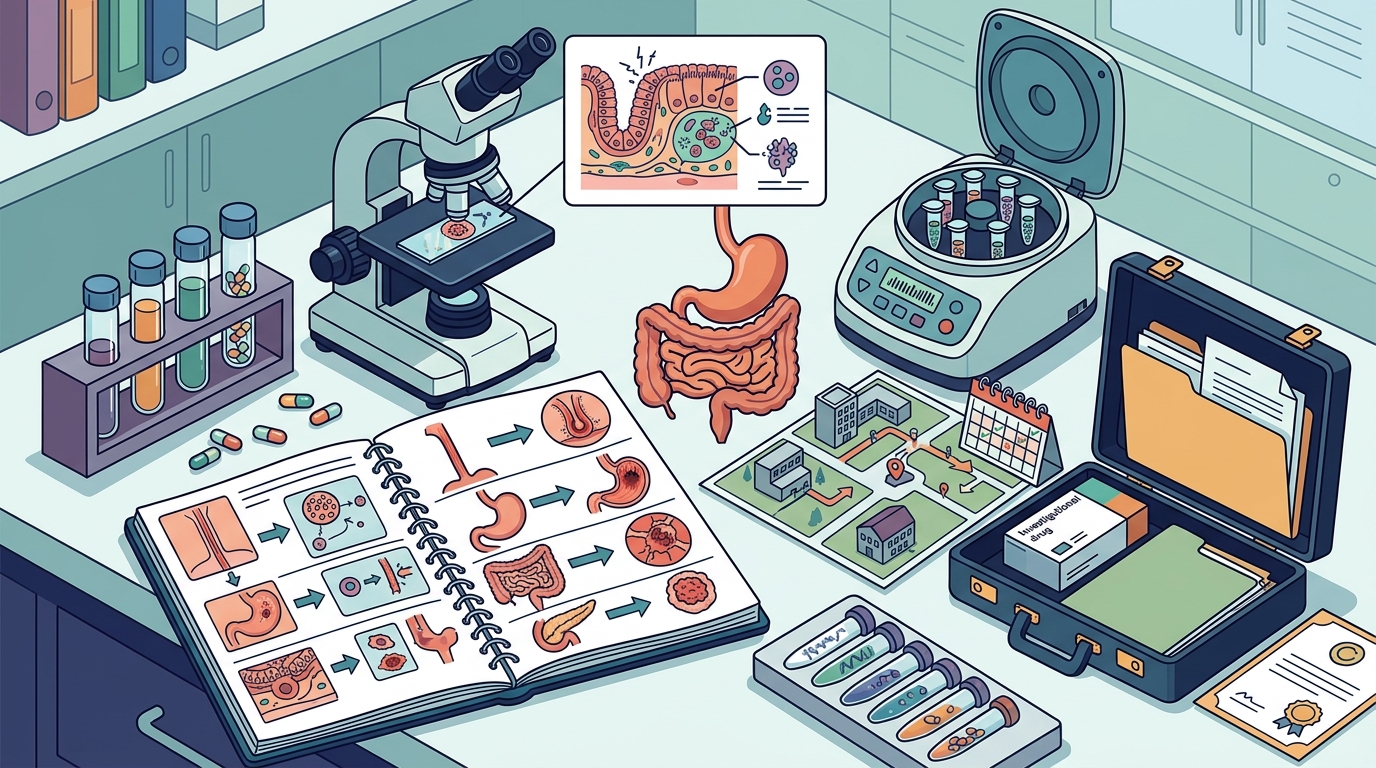
Where to Search for GI Trials
- ClinicalTrials.gov — The largest registry of clinical studies worldwide. Filter by condition (e.g., "ulcerative colitis"), status ("recruiting"), and location.
- Academic medical centres — Institutions such as UCSF and UC San Diego maintain dedicated GI trial listings.
- Specialty research sites — Organisations focused on gastroenterology research conduct trials across conditions including GERD, IBD, Crohn's disease, pancreatitis, colorectal cancer, and other GI cancers, giving participants access to cutting-edge treatments and expert medical care.
- Your gastroenterologist — Physicians embedded in hospital networks often know about trials before they appear in public registries.
Pathway 2 — FDA Expanded Access (Compassionate Use)
When clinical trial enrolment is not possible—because a patient is ineligible, no trials are open nearby, or the disease is progressing too quickly—the FDA offers an alternative. Expanded access is a potential pathway for a patient with a serious or life-threatening disease or condition to try an investigational medical product outside of clinical trials when there are no comparable or satisfactory therapies available.
Three Categories of Expanded Access
- Individual patient access (including emergency use) — A physician files FDA Form 3926 on behalf of a single patient. The FDA approves over 99 percent of these single-patient requests.
- Intermediate-size population access — Used when a group of patients share similar treatment needs but do not qualify for an existing trial.
- Widespread treatment IND — Provides access to a large population and is often used to bridge the gap between completion of clinical trials and marketing approval.
Who Is Involved?
The process requires cooperation among several parties: the patient's licensed physician, the drug manufacturer (who must agree to supply the drug), an Institutional Review Board (IRB), and the FDA itself. The physician should first contact the drug company to ensure it is willing to provide the investigational drug for expanded access use, then submit an IND application to the FDA.
Emergency Situations
In urgent cases, the FDA can authorise expanded access over the phone before a written submission is filed. Emergency requests can be submitted via telephone or other rapid communication methods by a licensed physician after receiving agreement from the manufacturer.
Pathway 3 — Right to Try Act
Signed into federal law in 2018, the Right to Try Act allows patients with life-threatening conditions to request investigational drugs directly from manufacturers after completing Phase I trials—without requiring FDA authorisation. This pathway is narrower than expanded access. It applies only when all approved treatments have been exhausted, the patient cannot participate in a clinical trial, and the manufacturer agrees to provide the drug. It does not compel any company to supply a product, and insurance coverage is not guaranteed.
Pathway 4 — Accelerated FDA Approvals
The FDA can grant accelerated approval based on surrogate endpoints—such as tumour response rate—rather than waiting for final overall survival data. Many recent FDA approvals for GI cancer drugs have used accelerated pathways, relying on early results like response rate or single-arm trials instead of stronger evidence from randomised studies. While this can get treatments to patients sooner, the actual benefit in survival is sometimes limited, and the FDA mandates post-marketing confirmatory trials.
For patients, this means some drugs reach the market years earlier than they otherwise would. Your oncologist or gastroenterologist can tell you whether a recently approved accelerated-pathway drug is relevant to your diagnosis.
Notable GI Trials Recruiting in 2026
The GI treatment pipeline is especially active right now. Here are examples across several conditions:
Ulcerative Colitis
- Tilpisertib fosmecarbil — A Phase II/III trial at multiple centres is evaluating this agent against placebo, with clinical response at Week 12 as the primary endpoint.
- D-2570 (TYK2 inhibitor) — A Phase 2, multicentre, double-blind, placebo-controlled trial with 120 participants, with estimated primary completion in July 2026.
- MORF-057 (oral integrin inhibitor) — Being tested in the EMERALD-2 Phase 2b trial with 282 participants, measuring clinical remission at 12 weeks.
- Upadacitinib for acute severe UC — A trial investigating whether this oral JAK inhibitor can safely and effectively treat hospitalised adults with acute severe ulcerative colitis.
- GS-1427 — A new compound under investigation for moderate to severe UC, compared with placebo.
Crohn's Disease
- TRX103 — A study testing the safety and efficacy of different doses in individuals with Crohn's disease.
- Risankizumab (paediatric) — Being assessed in children aged 2–17 with moderately to severely active CD who have had inadequate response to other therapies.
- Vedolizumab expanded access programme — Provides children and teenagers with UC or CD who completed a prior clinical study with continued access to vedolizumab IV until it becomes commercially available.
GI Cancers
- Durvalumab + FLOT — Now FDA-approved for early-stage gastric and GEJ cancers following surgery, after the MATTERHORN trial demonstrated significant improvements in event-free survival and overall survival.
- Encorafenib-based triplet therapy — The BREAKWATER trial established this as first-line standard for BRAF V600E-mutant metastatic colorectal cancer.
- Trastuzumab deruxtecan — Confirmed as a superior second-line therapy for gastric cancers through the DESTINY-Gastric04 trial.
Step-by-Step: How to Pursue Early Access to a GI Treatment
- Talk to your specialist. Ask your gastroenterologist or oncologist whether any investigational treatments are appropriate for your condition and stage of disease.
- Search trial databases. Use ClinicalTrials.gov, academic medical centre listings, and patient advocacy organisation registries to identify recruiting studies near you.
- Assess eligibility. Every trial has inclusion and exclusion criteria. Your medical team can review these with you.
- If trials are unavailable, explore expanded access. Your physician contacts the drug manufacturer, then submits FDA Form 3926. IRB review follows. The FDA typically responds within 30 days for non-emergency requests—or immediately by phone in emergencies.
- Understand the costs. Study drugs in clinical trials are usually free, but associated medical procedures may or may not be covered. In expanded access, the manufacturer may charge for the drug under certain conditions.
- Get a second opinion. An academic GI centre may be aware of trials or programmes your local physician is not.
Risks and Limitations to Understand
Investigational medical products have not yet been approved by the FDA and have not been found safe and effective for their specific use. The product may or may not work for your condition and could cause unexpected serious side effects. Clinical trials include informed consent processes and safety monitoring to mitigate these risks, but they cannot be eliminated entirely.
Expanded access also carries uncertainty. Not every drug company agrees to supply investigational products outside of trials. Geographic distance, insurance coverage gaps, and strict eligibility criteria remain barriers for many patients.
Key Takeaways
- Clinical trial enrolment is the preferred and most structured way to access investigational GI treatments.
- FDA expanded access (compassionate use) is available for patients with serious conditions who cannot join a trial—and over 99% of single-patient requests are authorised.
- The Right to Try Act offers a separate pathway but is narrower in scope and requires manufacturer agreement.
- Accelerated FDA approvals can bring GI drugs to market years earlier based on surrogate endpoints.
- Dozens of GI trials are actively recruiting in 2026 for conditions including ulcerative colitis, Crohn's disease, and GI cancers.
- Always begin by speaking with your gastroenterologist or oncologist, who can guide you toward the most appropriate pathway.
Frequently Asked Questions
What is expanded access (compassionate use) for GI treatments?
Expanded access is a pathway that allows patients with serious or life-threatening gastrointestinal diseases to receive an investigational drug, biologic, or device outside of a clinical trial when no comparable or satisfactory approved therapy is available. It requires cooperation among the patient's physician, the drug manufacturer, an IRB, and the FDA.
How do I find gastrointestinal clinical trials near me?
Start with ClinicalTrials.gov and filter by your specific condition and location. Academic medical centres like UCSF and UC San Diego maintain dedicated GI trial pages. You can also ask your gastroenterologist, who may have direct connections to research networks.
Does the FDA approve most expanded access requests?
Yes. The FDA allows over 99 percent of single-patient expanded access requests to proceed. In emergency situations, authorisation can be granted by phone before written paperwork is submitted.
What is the difference between expanded access and Right to Try?
Expanded access requires FDA authorisation, an IRB review, and manufacturer agreement. Right to Try, established by federal law in 2018, bypasses FDA involvement but still requires manufacturer agreement and is limited to patients who have exhausted all approved treatments and cannot join a clinical trial.
Are there new ulcerative colitis treatments in clinical trials right now?
Yes. As of 2026, multiple trials are recruiting for moderate to severe UC, including studies of the TYK2 inhibitor D-2570, the oral integrin inhibitor MORF-057 (EMERALD-2 trial), tilpisertib fosmecarbil, upadacitinib for acute severe UC, and the investigational compound GS-1427.
Can I access investigational GI cancer drugs before they are approved?
Yes, through clinical trial participation or expanded access. Many recent GI cancer drugs have also reached patients faster through the FDA's accelerated approval pathway, which relies on surrogate endpoints such as tumour response rate to grant earlier market access while confirmatory trials continue.