

Fatty liver disease—now formally called metabolic dysfunction–associated steatotic liver disease (MASLD)—has become an urgent public health challenge. A 2025 modeling study published in JAMA Network Open estimated that MASLD prevalence would rise from 33.7% of U.S. adults in 2020 to 41.4% by 2050, translating to roughly 122 million people. Jacksonville, Florida, is home to several research organizations actively enrolling participants in clinical trials that could change how this disease is treated. This guide walks you through every option, what to expect, and how to get started.
Why MASLD and MASH Matter More Than Ever
MASLD (formerly NAFLD) encompasses a spectrum of liver conditions ranging from simple fat accumulation to serious inflammation and scarring. When the disease advances to metabolic dysfunction–associated steatohepatitis (MASH, formerly NASH), the stakes rise dramatically.
- An estimated 25–30% of U.S. adults aged 15 and older live with MASLD, and approximately 22 million adult Americans are estimated to have MASH.
- Modeling predicts MASH cases will grow from 14.9 million in 2020 to 23.2 million by 2050, with liver-related deaths nearly tripling from 30,500 to 95,300 annually.
- MASH is on track to become the leading indication for liver transplantation in the United States.
These numbers explain why clinical research sites in Jacksonville are actively seeking volunteers—developing and testing the next generation of therapies is critical.
How Clinical Trials for Fatty Liver Disease Work
Understanding the trial process can ease anxiety for first-time participants. During fatty liver clinical trials, patients typically undergo blood tests, imaging scans such as ultrasounds or MRIs, and sometimes liver biopsies. Participants may receive either the investigational treatment or a placebo, and a medical team closely monitors their response, side effects, and overall health throughout the study.
FibroScan: The Gateway Screening Tool
Many Jacksonville research sites use FibroScan as an initial screening method. FibroScan is a painless, non-invasive ultrasound-based imaging tool that measures liver stiffness and fat accumulation. It requires no sedation and can be completed in just a few minutes, making it far less burdensome than a traditional liver biopsy. In fact, the examination volume of a FibroScan is 100 times the size of a typical liver biopsy, significantly reducing sampling error.
Top Facilities for Fatty Liver Clinical Research in Jacksonville
Below are the key organizations conducting fatty liver disease research in and around Jacksonville, each bringing unique strengths.
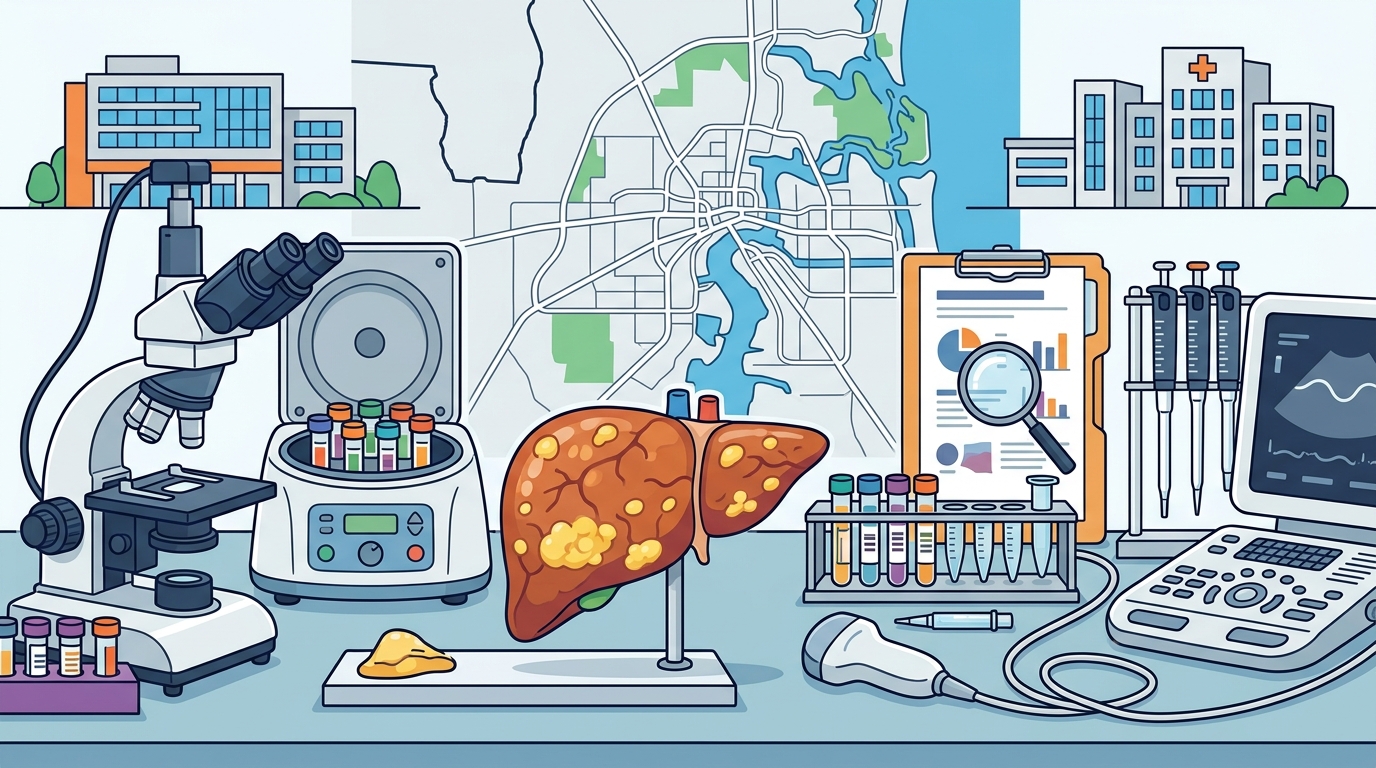
1. Encore Borland Groover Clinical Research (EBGCR) — Southside
EBGCR is a partnership formed in 2019 between ENCORE Research Group and Borland Groover's Division of Research. Located at 4800 Belfort Road, Suite 301, Jacksonville, FL 32256, EBGCR specializes in gastrointestinal clinical research and has direct access to a massive patient network—Borland Groover investigators provide care for more than 100,000 patients each year with digestive disorders. The medical director, Dr. Bharat Misra, leads a team of experienced gastroenterologists including investigators like Dr. Vikram Gopal and Dr. Fleisher, who have presented at national meetings and published in leading scientific journals.
EBGCR is currently participating in the SYNCHRONY study for fatty liver disease as part of the broader ENCORE research network. They also offer complimentary FibroScan screenings, providing a quick, non-invasive way to assess liver health and determine trial eligibility.
Contact: (904) 680-0871 | research@borlandgroover.com
2. EBGCR — Westside Jacksonville
The Westside location at 810 Lane Avenue South, Jacksonville, FL 32205, extends EBGCR's reach into a different part of the city. This site features experienced physicians including H. Jackson Downey, MD, who specializes in family medicine and brings a prevention-focused philosophy to clinical research. Staff members at this location have decades of research experience, with some team members having worked in clinical research operations for over 20 years.
Contact: (904) 693-1490
3. Fleming Island Center for Clinical Research
Located at 1679 Eagle Harbor Parkway, Suite D, 2nd Floor, Fleming Island, FL 32003, this satellite site is part of the ENCORE network and offers fatty liver trials to residents south of Jacksonville in the Clay County area. It provides convenient access for participants who live outside the urban core.
Contact: (904) 621-0390
4. Jacksonville Center for Clinical Research (JCCR)
JCCR is one of Jacksonville's longest-running research organizations, led by cardiologist Dr. Michael Koren. The center played a significant role in testing resmetirom, the first FDA-approved drug for MASH with liver fibrosis. According to local reporting, the drug showed promising results during trials conducted in Jacksonville, with Dr. Koren noting that fatty liver disease has become the number-one reason for referral for a liver transplant. JCCR has participated in hundreds of clinical trials spanning cardiovascular, metabolic, and liver diseases.
A Landmark Breakthrough: Resmetirom and Jacksonville's Role
In March 2024, the FDA granted accelerated approval to resmetirom (brand name Rezdiffra) for the treatment of MASH with moderate to advanced liver fibrosis (stages F2–F3). This approval was based on the MAESTRO-NASH trial, which demonstrated that NASH resolution with no worsening of fibrosis was achieved in 25.9% of patients in the 80 mg resmetirom group and 29.9% in the 100 mg group, compared to just 9.7% in the placebo group. Fibrosis improvement by at least one stage was seen in 24.2% (80 mg) and 25.9% (100 mg) of patients versus 14.2% on placebo.
Jacksonville-based investigators contributed to the broader clinical trial infrastructure that made this approval possible, highlighting the city's growing importance in liver disease research.
Newer Therapies on the Horizon
Resmetirom is not the only molecule under investigation. Florida currently has multiple active MASH clinical trials running across cities including Jacksonville, with investigational approaches ranging from gene-silencing therapies (such as ALN-HSD) to FGF21 analogs like pegozafermin, which is being evaluated in the ENLIGHTEN-Fibrosis study for patients with stage 2 or 3 liver fibrosis.
Additionally, in August 2025, the FDA expanded the indication for semaglutide to include the treatment of MASH in adults with moderate-to-advanced fibrosis. Trials showed MASH resolution rates as high as 63% in some cohorts, opening another avenue of treatment that may be studied further in Jacksonville sites.
Who Qualifies for a Fatty Liver Clinical Trial?
Eligibility criteria vary by study, but common requirements include:
- Age: Most trials enroll adults 18 and older, though some pediatric studies exist.
- Diagnosis: Participants typically need diagnosed or suspected fatty liver disease, confirmed through imaging, blood work, or biopsy.
- Fibrosis stage: Many current trials target patients with fibrosis stages F1B through F3.
- Metabolic risk factors: Conditions such as type 2 diabetes, obesity, and dyslipidemia are common co-inclusion criteria.
- Exclusions: Other causes of liver disease—including alcoholic liver disease, autoimmune hepatitis, Wilson disease, and alpha-1-antitrypsin deficiency—are typically excluded.
A free screening, often using a FibroScan, is the simplest way to find out whether you meet the criteria for a specific study.
Benefits and Considerations of Participating
Potential Benefits
- Early access to new therapies: Participants may receive investigational treatments not yet available to the general public.
- Expert medical monitoring: Qualified doctors, nurses, and study coordinators provide support and care throughout the trial.
- No cost for study-related care: Most trials cover the cost of study-related exams, lab work, and medications. No health insurance is required.
- Contributing to science: Volunteering helps researchers learn more about curing, preventing, and treating liver disease, improving healthcare for future patients.
Important Considerations
- You may receive a placebo instead of the active treatment.
- There can be side effects; for example, the MAESTRO trials noted that diarrhea and nausea were more common in resmetirom groups at the start of treatment.
- Trials require regular visits, blood draws, and adherence to the study protocol.
- Every clinical trial in the U.S. must be approved by an Institutional Review Board (IRB), which is an independent committee ensuring the study is ethical and participants' rights are protected.
Step-by-Step: How to Enroll in a Jacksonville Fatty Liver Trial
- Self-assess your risk: Do you have obesity, type 2 diabetes, high cholesterol, or a family history of liver disease? These are common risk factors for MASLD.
- Schedule a FibroScan: Contact EBGCR or another Jacksonville research site and ask for a complimentary liver scan.
- Consult the research team: A coordinator will review your medical history and screening results to match you with an appropriate study.
- Informed consent: You will receive a full explanation of the study's risks, benefits, and procedures before deciding to participate.
- Begin the study: Follow the visit schedule, take study medications as directed, and attend all follow-up appointments.
Key Takeaways
- MASLD affects an estimated one-third of U.S. adults and is projected to become even more prevalent in the decades ahead.
- Jacksonville has multiple clinical research facilities—including EBGCR Southside, EBGCR Westside, Fleming Island Center, and JCCR—actively enrolling participants in fatty liver disease trials.
- The 2024 FDA approval of resmetirom for MASH with fibrosis was a historic milestone, and Jacksonville researchers contributed to the clinical trial ecosystem behind it.
- Newer therapies including gene-silencing drugs and GLP-1 receptor agonists like semaglutide are expanding the treatment pipeline.
- FibroScan screenings offered at Jacksonville sites are a fast, painless first step to determining eligibility.
- Participation is voluntary, typically free of charge for study-related care, and overseen by independent ethical review boards.
Frequently Asked Questions
What is the difference between MASLD and MASH?
MASLD (metabolic dysfunction–associated steatotic liver disease) is the broad term for liver conditions involving excess fat accumulation linked to metabolic risk factors. MASH (metabolic dysfunction–associated steatohepatitis) is a more severe form in which inflammation and liver cell damage are present, which can progress to fibrosis, cirrhosis, and liver failure.
Is there an FDA-approved drug for fatty liver disease?
Yes. In March 2024, resmetirom received accelerated FDA approval for the treatment of MASH with moderate to advanced liver fibrosis (stages F2–F3). In August 2025, semaglutide also received an expanded indication for MASH in adults with moderate-to-advanced fibrosis.
Do I need health insurance to participate in a clinical trial?
No. Study-related medical care, including exams, lab work, and investigational medications, is typically provided at no cost to participants.
What is a FibroScan and does it hurt?
FibroScan is a non-invasive ultrasound-based tool that measures liver stiffness and fat content. The procedure is painless, requires no sedation, and takes only a few minutes.
Where can I sign up for a fatty liver clinical trial in Jacksonville?
You can contact Encore Borland Groover Clinical Research (EBGCR) at (904) 680-0871 or visit ebgcr.com to learn about currently enrolling studies. Additional ENCORE network sites on the Westside and in Fleming Island also accept participants.